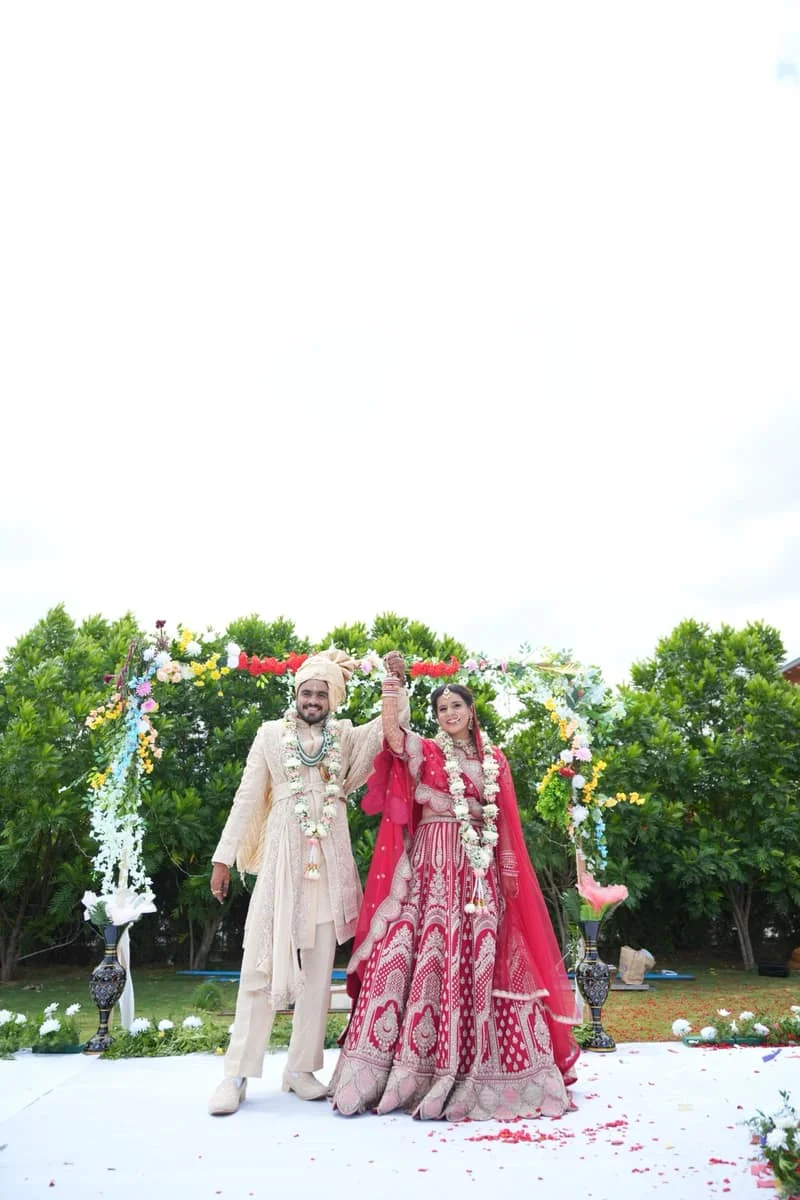
Why Is the Roka the Hardest Function to Judge?
The Roka is the first time the two families sit in a room together, usually at home, usually in daylight, with perhaps thirty people present. The difficulty is that it is a formal ceremony held in an informal setting. Overdress and you look as though you have misread the day; underdress and you look as though you did not take it seriously. The register that works is a considered kurta set rather than anything ceremonial.
| What the Roka is | What it means for the outfit |
|---|---|
| Held at home or a small venue | Soft daytime light; saturated colour reads harsh |
| Both families meeting formally | Covered, neat, and quietly good rather than eye-catching |
| Seated on sofas and floors | Ease through the seat and thigh matters more than structure |
| First of many functions | Nothing that competes with the wedding-day wardrobe |
What Should You Actually Wear?
- Kurta set with a Nehru jacket: the standard answer, and the most reusable.
- Colours: ivory, sage, dusty pink, powder blue. Warm, soft tones photograph well in home lighting.
- Fabric: silk-cotton or fine raw silk. Heavy brocade is too much for a daytime sitting room.
- Embroidery: restrained, at the placket and cuffs if at all.
- Footwear: mojaris you can slip off at the door.
How Is a Roka Different From a Sagai?
The Roka is smaller, earlier, held in daylight and usually at home; the Sagai is an evening event at a hall with a wider guest list and the ring exchange photographed in close-up. Practically, that means the Roka takes a kurta set and the Sagai takes a bandhgala, a lightly embroidered sherwani or a sharp three-piece. If you are doing both, plan them together so the Roka outfit is not simply a weaker version of the Sagai one. See Sagai outfits.
Can You Wear It Again?
Yes, and it is the main argument for having it made. A well-cut Roka kurta set carries into Diwali, a daytime engagement as a guest, a naming ceremony or a temple visit for years afterwards. Choose the colour for that second life as much as for the day itself: ivory and sage travel much further than a novelty shade.
What Does It Cost, and How Long Does It Take?
| Garment | From | Typical range | Lead time |
|---|---|---|---|
| Designer Kurtas & Casual Ceremonial | ₹5,500 | ₹5,500 – ₹25,000+ | 1–6 weeks |
Our published starting prices and typical ranges, plus the usual atelier lead time before the fitting. Every commission is quoted individually at the consultation, because cloth, construction and the hours of hand embroidery move the figure more than anything else. Unstitched silks such as a veshti, panche or mundu are not included.
If the date is close, our Express service offers same-day, next-day or 2-day delivery, subject to fabric availability and design.
Commission the Outfit
Every garment is drafted from roughly 20 to 25 of your own measurements and cut from our own fabric library. One fitting is standard before the garment is finished, and alterations are covered for one month after delivery or until the garment has been worn, whichever comes first. Read how we work, plan the full wedding with the wardrobe planner, or book a consultation in Basavanagudi.
Sources
- Roka, Wikipedia
- Weddings in India, Wikipedia