

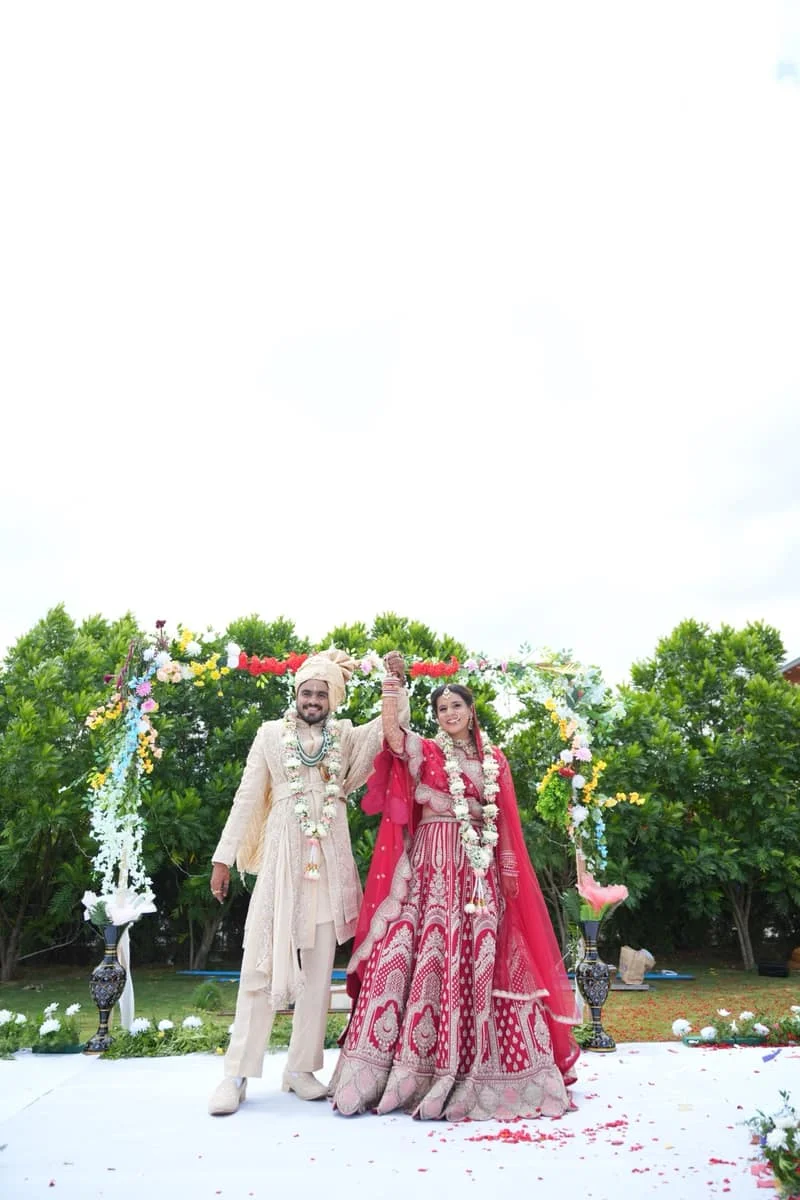
Why Is the Muhurtham the Hardest Garment to Get Right?
It is worn for the longest stretch, in front of the people whose opinion matters most, and photographed from every angle for hours. It is also usually the most traditional garment of the wedding, which means the margin for personal interpretation is narrow. Everything that follows in the sequence is easier.
| Demand | What it means for the cut and cloth |
|---|---|
| Worn 4 to 8 hours, often from dawn | Pure silk that breathes; dense brocade becomes punishing |
| Seated cross-legged for rituals | Ease through seat and thigh planned at the pattern stage |
| Close family scrutiny | Regional convention outranks personal preference |
| Temple and daylight mixed lighting | Cream, ivory and gold read correctly in both |
Silk Kurta, Veshti or Sherwani?
In Karnataka and Tamil Nadu, a silk kurta with a veshti, or the panche, is the traditional answer and the one most families expect. A sherwani is increasingly worn at South Indian weddings, but it belongs more comfortably at the reception than at the core ceremony unless your family has already adopted it. Ask before you commission: this is the one garment where getting the register wrong is visible to everyone in the room.
Which Fabric Survives the Day?
- Pure silk: drapes correctly, holds embroidery, photographs properly. The standard.
- Silk-cotton: more breathable for a long daytime ceremony in heat.
- Raw and matka silk: matte texture, less glare under direct light.
- Avoid: heavy brocade for a dawn-to-noon ceremony, and any synthetic near a fire ritual.
How Early Should You Start?
Three to four months before the wedding. A hand-embroidered ceremonial garment takes one to six weeks on its own, and the fitting has to sit inside that window rather than after it. Starting late is the single most common reason a groom ends up with something bought rather than made. Regional detail is in our Karnataka and Tamil Nadu guide.
What Does It Cost, and How Long Does It Take?
| Garment | From | Typical range | Lead time |
|---|---|---|---|
| Designer Kurtas & Casual Ceremonial | ₹5,500 | ₹5,500 – ₹25,000+ | 1–6 weeks |
| Handcrafted Wedding Sherwanis | ₹20,000 | ₹20,000 – ₹1,20,000+ | 1–6 weeks |
Our published starting prices and typical ranges, plus the usual atelier lead time before the fitting. Every commission is quoted individually at the consultation, because cloth, construction and the hours of hand embroidery move the figure more than anything else. Unstitched silks such as a veshti, panche or mundu are not included.
Unstitched silks such as a veshti, panche or angavastram are not included above.
If the date is close, our Express service offers same-day, next-day or 2-day delivery, subject to fabric availability and design.
Commission the Outfit
Every garment is drafted from roughly 20 to 25 of your own measurements and cut from our own fabric library. One fitting is standard before the garment is finished, and alterations are covered for one month after delivery or until the garment has been worn, whichever comes first. Read how we work, plan every function with the wardrobe planner, or book a consultation in Basavanagudi.
Sources
- Veshti, Wikipedia
- Weddings in India, Wikipedia


